Materials used, function and Constructional details of Petrol Engine Components
Engine consists of the following parts.
1. Cylinder block 2. Cylinder head
3. Crankcase 4. Piston
5. Piston Rings 6. Piston Pin
7. Connecting Rod 8. Crankshaft
9. Flywheel 10. Valves and valve mechanism
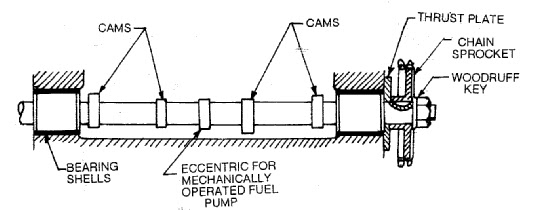
11. Rocker Arm 12. Camshaft
besides the above components engine contain so many accessories like aircleaner, oil filter, automatic chokes, automatic heat controls, spark plug, ignition devices, carburetors, manifolds, vibration damper etc.
Materials used for various components:
The cylinder block and cylinder heat are made of gray cast iron and sometimes with addition of nickel and chromium. Some cylinder blocks are cast from aluminum, cast iron or steel. The cylinder blocks are made of
casting process. Small engine cylinder blocks walls are plated with chromium to reduce wall wear and to increase their service life.
The cylinder gaskets are made of copper-asbestos, steel asbestos and stainless steel. The upper part of the crankcase is made of ferrous alloy or semi-steel to provide a stronger and harder casing.
The cylinder liners are barrels made of special alloy iron containing silicon, manganese, nickel and chromium. The cylinder liners are centrifugal castings.
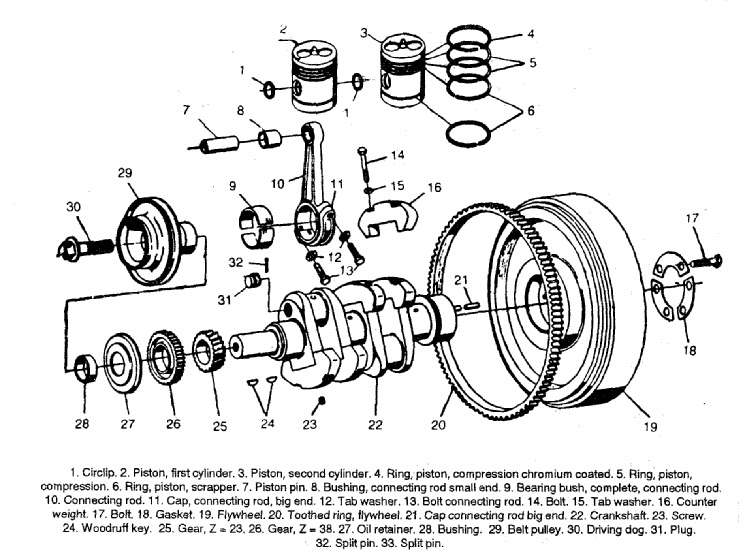
The piston is the most important part in the engine which converts chemical energy into mechanical power. As the piston is to convey the expansion of the gases via connecting rod it is made of aluminum alloy by the process of either cast or forged. As the conductivity of aluminum alloy is more than cast
iron, it is made of aluminum alloy.
The piston rings are coated to minimize the wear. The piston rings are coated with chromium plating to decrease the rate of wear. Ring coating absorbs oil thus improving lubrication. The piston rings are castings.
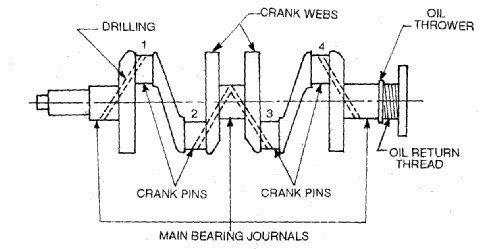
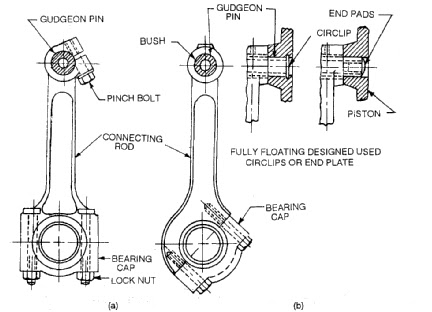
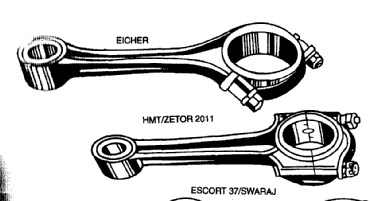
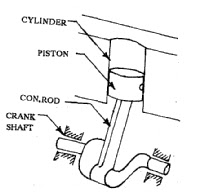
The connecting rod is generally I-beam cross-section and is made of forged steel. Aluminum alloy is also used for connecting rods. But they are carefully matched in sets of uniform weight in order to maintain engine balance. The connecting rod is made of forging process. The crankshaft is made of casting or forging of heat treatment alloy steel and is machined and ground to provide suitable journals for the connecting rod
and main bearing. The flywheel is a fairly heavy bulk mass of steel attached to the crankshaft. The size of the flywheel depends upon the number of cylinders and the general construction of the engines. During the power stroke the engine tends to speed up and during the other three strokes it tends to slow down. The
inertial of the flywheel tends to keep it running at constant speed.
The valves are usually made of austenitic stainless steel which is a corrosion and heat resistant material. Exhaust valve is made of silchrome steel which is an alloy of silicon and chromium with unusual resistance to heat. Inlet valve is usually made of nickel chromium alloy steel.